

For many Australian families, children’s dental care feels easier to plan once you understand what Medicare can and cannot help with. In most cases, when parents ask about “Medicare dental benefits”, they are referring to the Child Dental Benefits Schedule, usually called the CDBS.
The CDBS is designed to help eligible children access basic dental care, including preventive visits and common treatments such as fillings. It does not cover every dental service, and eligibility depends on your child’s age, Medicare status and certain government payments received by the family.
Here is a practical guide for parents on what is covered, what is excluded and how to make the most of your child’s benefits before booking an appointment.
Medicare dental benefits for children: the short answer
Medicare does not usually cover routine dental treatment in the same way it covers visits to a GP. However, eligible children may receive dental support through the Child Dental Benefits Schedule.
According to Services Australia’s guidance on the Child Dental Benefits Schedule, the program helps pay for a range of basic dental services for children who meet the criteria. The benefit is capped, applies over a set period and is paid toward approved dental items.
In simple terms, the CDBS can help eligible families pay for:
- Dental examinations and check-ups
- X-rays where clinically needed
- Cleaning and preventive care
- Fissure sealing
- Fillings
- Root canal treatment
- Tooth extractions
It does not cover orthodontics, cosmetic dental work or dental services provided in a hospital setting.
Who is eligible for children’s Medicare dental benefits?
A child may be eligible for the Child Dental Benefits Schedule if they meet the age, Medicare and payment requirements. Eligibility can change from year to year, so it is worth checking before every course of treatment rather than assuming the benefit is still available.
Generally, eligible children must be aged 0 to 17 years for at least one day of the calendar year, be eligible for Medicare and be part of a family receiving an eligible Australian Government payment. Family Tax Benefit Part A is one common example, although it is not the only payment that may qualify.
The full list of eligible payments is maintained by Services Australia, so parents should check their Medicare account, myGov account or contact Medicare if they are unsure.
| Eligibility factor | What it means for families |
|---|---|
| Age | The child must be within the eligible age range during the calendar year. |
| Medicare status | The child must be eligible for Medicare. |
| Government payment | The family, carer or child must receive an eligible payment for at least part of the year. |
| Benefit balance | The child must have enough benefit remaining for the planned treatment. |
If your child is eligible, you may receive a notification from Medicare. However, it is still a good idea to confirm their balance before treatment, especially if they have used the benefit before.
How the CDBS benefit period works
The Child Dental Benefits Schedule is not an unlimited dental allowance. It provides a capped amount that can be used over two consecutive calendar years. The cap is indexed over time, so the exact available amount can change. For the most accurate figure, check your child’s Medicare balance through myGov, the Express Plus Medicare app, Medicare directly or your dental clinic before treatment begins.
The benefit is not paid to families as cash. Instead, it is applied to eligible dental services provided by a dentist who participates in the scheme. If your child uses the full benefit before the two-year period ends, there may be no CDBS balance left until a new benefit period begins, if they remain eligible.
Any unused amount does not simply continue indefinitely. This is why preventive dental visits can be a smart way to use the benefit, rather than waiting until a child has pain, decay or a dental emergency.
What Medicare dental benefits cover for eligible children
The CDBS focuses on basic dental services. These are the types of treatments that help diagnose dental problems, prevent decay and treat common oral health issues in children.
| Service type | Usually covered under CDBS? | Notes for parents |
|---|---|---|
| Dental check-ups | Yes | Helps detect decay, gum issues, bite concerns and oral hygiene problems early. |
| X-rays | Yes, when needed | Used when the dentist needs more information than a visual exam can provide. |
| Cleaning | Yes | May include removal of plaque and calculus, depending on your child’s needs. |
| Fissure seals | Yes | Protective coatings placed on grooves of back teeth to reduce decay risk. |
| Fillings | Yes | Used to repair teeth affected by decay or minor damage. |
| Root canal treatment | Yes | May be covered when clinically appropriate for a child’s tooth. |
| Extractions | Yes | Covered when a tooth needs to be removed for dental health reasons. |
| Orthodontics or braces | No | Braces, aligners and orthodontic treatment are not covered. |
| Cosmetic dentistry | No | Treatments done purely for appearance are not covered. |
| Hospital dental services | No | Dental services provided in hospital are excluded from CDBS. |
The key phrase is “clinically appropriate”. A dentist still needs to assess your child and recommend treatment based on their oral health, not simply because a service is listed as covered.
What is not covered by the Child Dental Benefits Schedule?
Just as important as knowing what is covered is understanding what is excluded. Medicare dental benefits for children are aimed at essential and preventive dental care, not elective or specialist treatments outside the CDBS item list.
The CDBS does not cover orthodontic treatment, including braces, clear aligners or retainers used as part of orthodontics. It also does not cover cosmetic dental treatments, such as whitening or appearance-focused procedures that are not clinically necessary.
Dental services provided in a hospital are also excluded. This can matter if a child requires treatment under general anaesthetic, specialist hospital care or a procedure that is billed through a hospital rather than a dental clinic.
Some services may also have item limits or require a sufficient remaining balance. Before starting treatment, your dentist should explain what is recommended, what is covered and whether any out-of-pocket cost may apply.
What does bulk billing mean for children’s dental care?
When a dental clinic bulk bills eligible children under the CDBS, it generally means the clinic accepts the Medicare benefit as payment for eligible services, so there is no out-of-pocket cost for those covered items.
This is different from assuming every appointment or treatment will automatically be free. Bulk billing depends on your child’s eligibility, their remaining CDBS balance, the treatment required and the clinic’s billing arrangements.
Before treatment, ask the clinic:
- Is my child eligible for CDBS today?
- How much benefit do they have remaining?
- Will the planned treatment be bulk billed?
- Are there any services that are not covered?
- Will I need to pay anything on the day?
Bright Smiles Dentistry supports children’s bulk billing and offers family-focused dental care at Mountain Creek/Brightwater and Currimundi. If you are unsure whether your child’s visit can be billed under Medicare dental benefits, the team can help you check before treatment begins.
When should parents use Medicare dental benefits?
The best time to use children’s dental benefits is not only when something hurts. Preventive care is often where the CDBS provides the most value, because regular check-ups can help identify small problems before they become painful, stressful or more expensive to treat.
For many families, a sensible approach is to use the benefit for routine examinations, cleaning, fissure seals if recommended and early treatment of decay. This can help children build confidence at the dentist and reduce the chance of needing more complex care later.
If your child already has a toothache, swelling, a broken tooth or pain while eating, it is worth arranging a dental appointment promptly. Parents of very young children may also find this guide on how to manage a toddler’s toothache helpful while organising professional care.
How to prepare for your child’s appointment
A little preparation can make the appointment smoother and help avoid surprises about costs or coverage. Bring your child’s Medicare card and any relevant concession or payment information if requested by the clinic. If another parent or carer usually manages Medicare details, confirm the child’s eligibility and balance before the visit.
It is also helpful to tell the dentist about any symptoms, past dental treatment, medical conditions, allergies or anxiety. Children who feel nervous often do better when the visit is calm, predictable and age-appropriate. If you are choosing a new provider, this article on finding a family-friendly dentist near you explains what to look for in a child-focused dental practice.
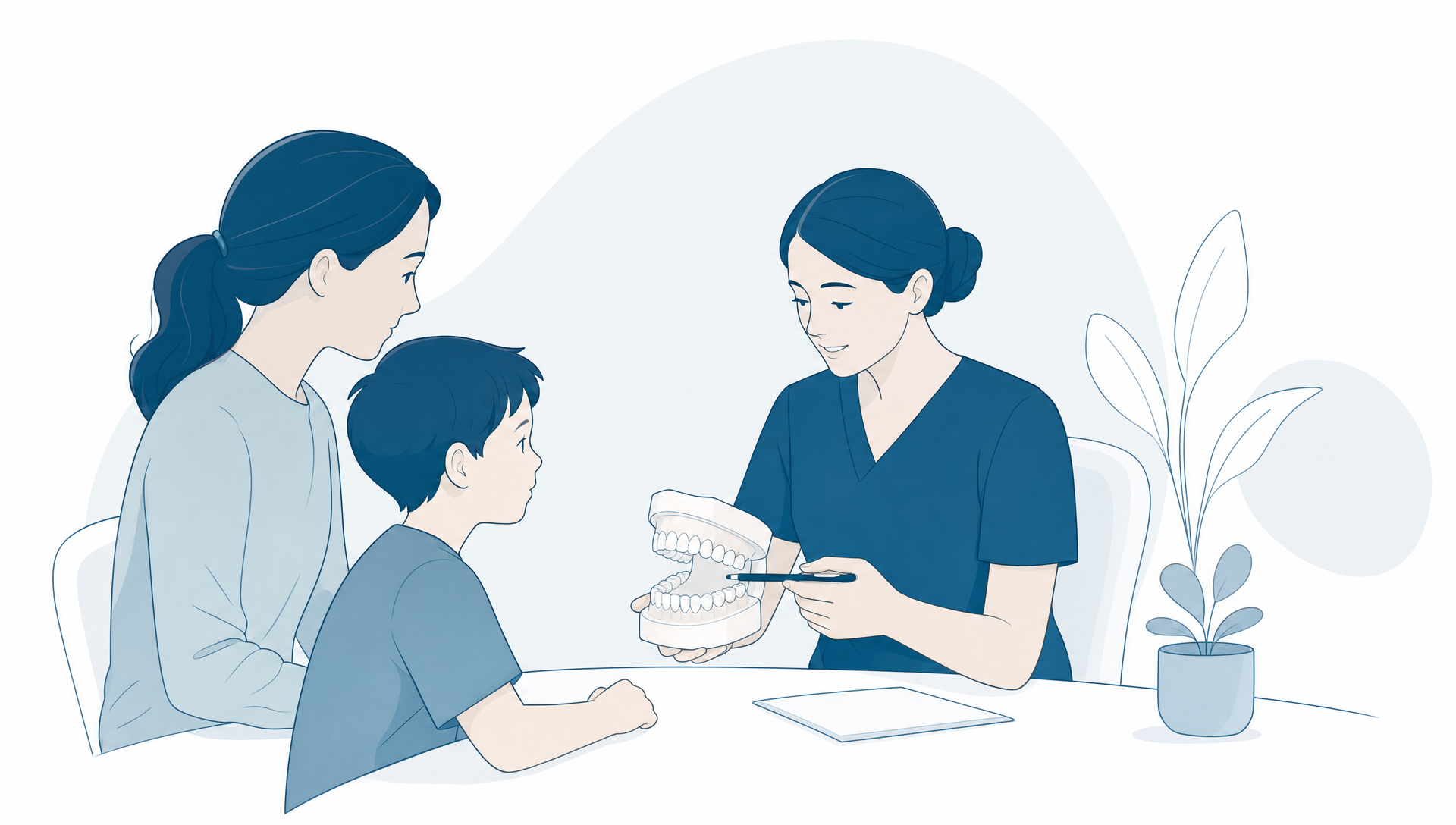
During the appointment, the dentist should discuss findings and treatment options with you. If CDBS is being used, you should be told which services are covered and asked for consent before treatment proceeds.
Common examples of what may be covered
A routine check-up for an eligible child may be covered if the clinic accepts CDBS billing and your child has enough balance remaining. If the dentist recommends X-rays, cleaning or fissure seals, those may also be covered if clinically appropriate and within the scheme rules.
If a child has a cavity, a filling may be covered. If a tooth is badly damaged or infected, root canal treatment or extraction may be covered in some circumstances. The right treatment depends on the child’s age, the tooth involved, symptoms, oral health and the dentist’s clinical judgement.
Braces are a common point of confusion. Even if orthodontic treatment is important for a child’s bite or future dental development, orthodontics is not covered by the Child Dental Benefits Schedule. Families considering braces should ask their dentist or orthodontic provider about treatment costs and payment options.
Frequently Asked Questions
Are Medicare dental benefits the same as free dental for all children? No. Medicare dental benefits for children usually refer to the Child Dental Benefits Schedule, which is only available to eligible children and has a capped benefit amount.
Can I use CDBS at a private dentist? Yes, many private dental clinics can provide treatment under the CDBS. Always confirm that the clinic accepts CDBS and whether your child’s planned treatment can be bulk billed.
Does CDBS cover braces? No. Orthodontics, including braces and clear aligners, is not covered under the Child Dental Benefits Schedule.
Does CDBS cover emergency dental treatment? It may cover eligible dental items such as an examination, X-ray, filling or extraction if your child is eligible and has enough benefit remaining. Hospital dental services are not covered.
How do I check my child’s remaining balance? You can check through your Medicare online account linked to myGov, the Express Plus Medicare app, by contacting Medicare or by asking your dental clinic to check before treatment.
What happens if the treatment costs more than the remaining benefit? The dentist should explain this before treatment. You may need to pay the difference if the service is not fully covered or your child’s remaining balance is not enough.
Book a children’s dental appointment on the Sunshine Coast
If your child may be eligible for Medicare dental benefits, it is worth checking their CDBS status before delaying care. A simple check-up can help prevent small issues from becoming bigger problems, and eligible children may be able to access covered treatment with little or no out-of-pocket cost when bulk billed.
Bright Smiles Dentistry offers family dental care across two Sunshine Coast locations in Mountain Creek/Brightwater and Currimundi. To check your child’s eligibility, discuss children’s bulk billing or arrange a visit, you can book an appointment with Bright Smiles Dentistry.